
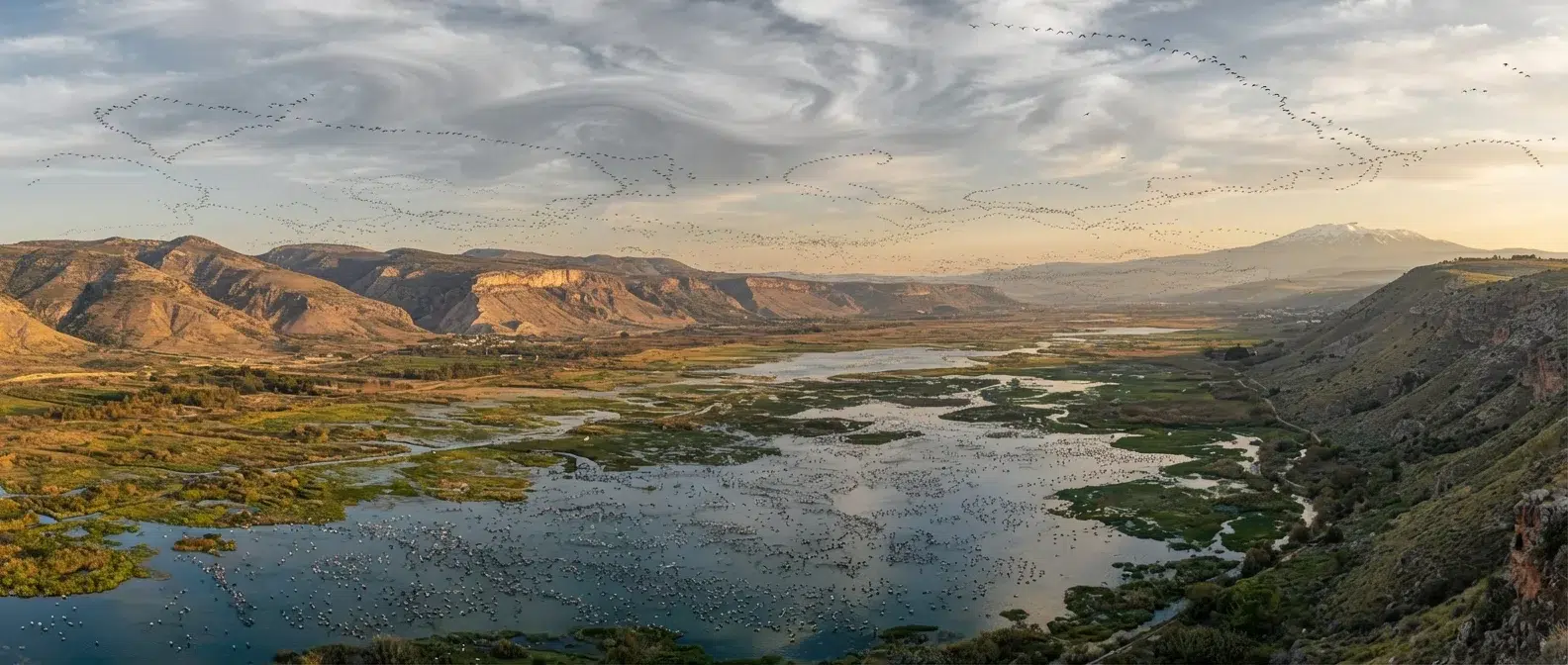
On October 6, 2026, the first cranes of the season landed at Hula Lake Park in northern Israel. They arrived at night, in family groups, after flying in from northern Russia, Finland and Estonia. Tens of thousands more are expected over the coming weeks.
They are only a small part of the story. Every autumn and spring, around half a billion birds cross Israel on their way between Europe, Asia and Africa. That is one of the great wildlife movements on Earth, and it happens over a country you can cross by car in a day. This guide explains why it happens here, what you can see right now, where to watch, and what to know before you go.
Why do half a billion birds fly over Israel?
Israel sits on a narrow land bridge between three continents. The Great Rift Valley runs through it, and it works like a highway for birds heading south for the winter or north for the spring.
Many of the biggest bird migrants, such as storks, pelicans and eagles, are soaring birds. They rely on rising warm air to glide and save energy, and warm air does not rise well over open sea. So these birds avoid long sea crossings and follow the land. The land route between Europe and Africa runs right through Israel.
According to the Israel Nature and Parks Authority, about half a billion birds pass through Israel out of roughly 11 billion migratory birds worldwide. Ecologists call the country a migration superpower. Birds also use daylight as their signal. As the days get shorter, they know it is time to leave.
What is happening right now
Bird migration in Israel(Autumn migration) runs from roughly September to mid-December, with different birds taking turns:
| When | What you may see |
| September | Storks and other large soaring birds pass in big numbers as the migration builds |
| Late September to October | Pelicans, birds of prey, flamingos, spoonbills, ibises and shorebirds at lakes and fish ponds |
| October to November | Cranes arrive in family groups, with young birds that hatched in spring |
| December to March | Many cranes stay for the winter in the Hula Valley |
| March (spring) | The return journey north, with the biggest show for birds of prey in the south, near Eilat |
These months are a guide, not a promise. Wind, rain and temperature move the timing every year, and numbers change from day to day.
The Hula Valley: the lake that was drained, then brought back
The best-known stopover is the Hula Valley in the Upper Galilee, a few kilometers from the northern border. It has a good story. In the 1950s the area was a large wetland, and the government drained it to create farmland. Decades later, people realized how much was lost, and in the 1990s authorities began to flood part of the valley again. The birds came back.
Today the restored lake, known as Agamon Hula, is one of the most important bird-watching sites in the world. In 2009, BBC Wildlife magazine named it among the best places on the planet for observing birds. Hundreds of species have been recorded in the valley, including cranes, pelicans, storks, herons, ibises and spoonbills.
The cranes: the stars of the show
Common cranes are the main attraction, and the reason many people plan a trip. They spend the night on the lake, which keeps them safe from predators. At sunrise they take off in waves to feed in the fields, and at sunset they come back. Watching thousands of them lift into the sky together is an experience that photographs only partly capture.
Counts vary by season and by day. Tens of thousands of cranes pass through in autumn, and many stay on for the winter. A park count in late December 2025, for example, found about 20,000 cranes at the lake as the wintering season began.
There is also a practical side to this story. Farmers in the valley set aside part of their land and scatter maize for the cranes in set places during winter, so the birds stay away from other crops. It is a rare example of farmers and wildlife finding a deal that works for both.
What a visit to Hula Lake Park is like
Hula Lake Park is about 15 kilometers south of Kiryat Shmona. A paved path of around 8.5 kilometers circles the lake, with lookouts, a visitor center and a café. You can walk it, rent a bike, or rent a golf cart. The site is wheelchair accessible.
Two things surprise first-time visitors. Private cars are not allowed inside the park, to protect the ecosystem, so you leave your car at the entrance. And entry has been free, with fees only for rentals and special tours, although you should always check the official site for current prices and hours.
The best moments are sunrise and sunset. Dawn is cold in late autumn, so bring layers. Special sunrise tours are offered in the season, and you may need to book ahead.
Beyond the Hula Valley: other places to watch
- The Beit She’an Valley. South of the Sea of Galilee, a cluster of fish ponds draws birds of prey, storks and pelicans looking for an easy meal.
- The Jerusalem Bird Observatory. A small urban refuge between the Knesset and the Supreme Court, with a bird-ringing center. It is a good stop if you are already in Jerusalem.
- Eilat. In the far south, Eilat is one of the best places in the world to watch migrating birds of prey. Its biggest rush is in spring, so autumn is the quieter season there.
- The Golan Heights and the Galilee. The Hula Valley lies in the Upper Galilee at the foot of the Golan Heights, so a morning with the cranes fits easily into a wider trip through the north, including the Golan Heights and the Sea of Galilee.
When to go and what to bring
- Time of day: Plan for sunrise or the hour before sunset.
- Season: Late October to December is a good window for cranes, and a bird festival is usually held in the Hula Valley in November. Dates change every year, so check ahead.
- Gear: Binoculars, a camera with a zoom lens, layers, a hat, and water.
- Manners: Keep your distance, stay quiet, and never feed or chase the birds.
- If you cannot travel: The park has offered live camera feeds online in the past, which is a great way to watch from home.
Traveling with children or older relatives? The paved loop makes this one of the easier nature visits in the north. See notes on traveling with families and for travelers with limited mobility.
Bird flu, closures and checking before you go
It is fair to say that things do not always go smoothly. In December 2021, an outbreak of avian flu killed thousands of cranes at Hula Lake Park, and the park was closed to visitors for a time. The northern reserves have also closed at times for security reasons. If you see a sick or dead bird, do not touch it, and tell the park staff.
Before you travel, confirm that the site is open and check current travel conditions in Israel. If this is your first visit to the country, the guide to a first trip to Israel covers the basics. The season can also change what you see in the north and the south, which is explained in how the season changes your route. If you are building a trip around the migration, take a look at what else northern Israel offers in the same days.
FAQs
When is the best time to see the autumn bird migration in Israel?
Autumn migration runs from about September to mid-December. Storks, pelicans and birds of prey are most visible in early autumn. Cranes begin to arrive in October and many stay through the winter, so late October to December is a strong window for the Hula Valley. Exact timing changes with the weather each year.
Do I need to be a birdwatcher to enjoy it?
No. Watching thousands of cranes leave the lake at sunrise is impressive for anyone. The paved path around Hula Lake Park is easy to walk or cycle, and binoculars make it better, but they are not required.
Is Hula Lake Park free, and can I drive in?
Entry to the park has been free, with fees for bike and golf cart rentals and special tours. Private cars are not allowed inside, so you park outside and walk, cycle, or rent a cart. Opening hours, prices and rules can change, so check the official site before your visit.