You will not see much for the first twenty minutes. That is the first thing to know about the night sky in the Negev, and the reason many first-timers give up too early.
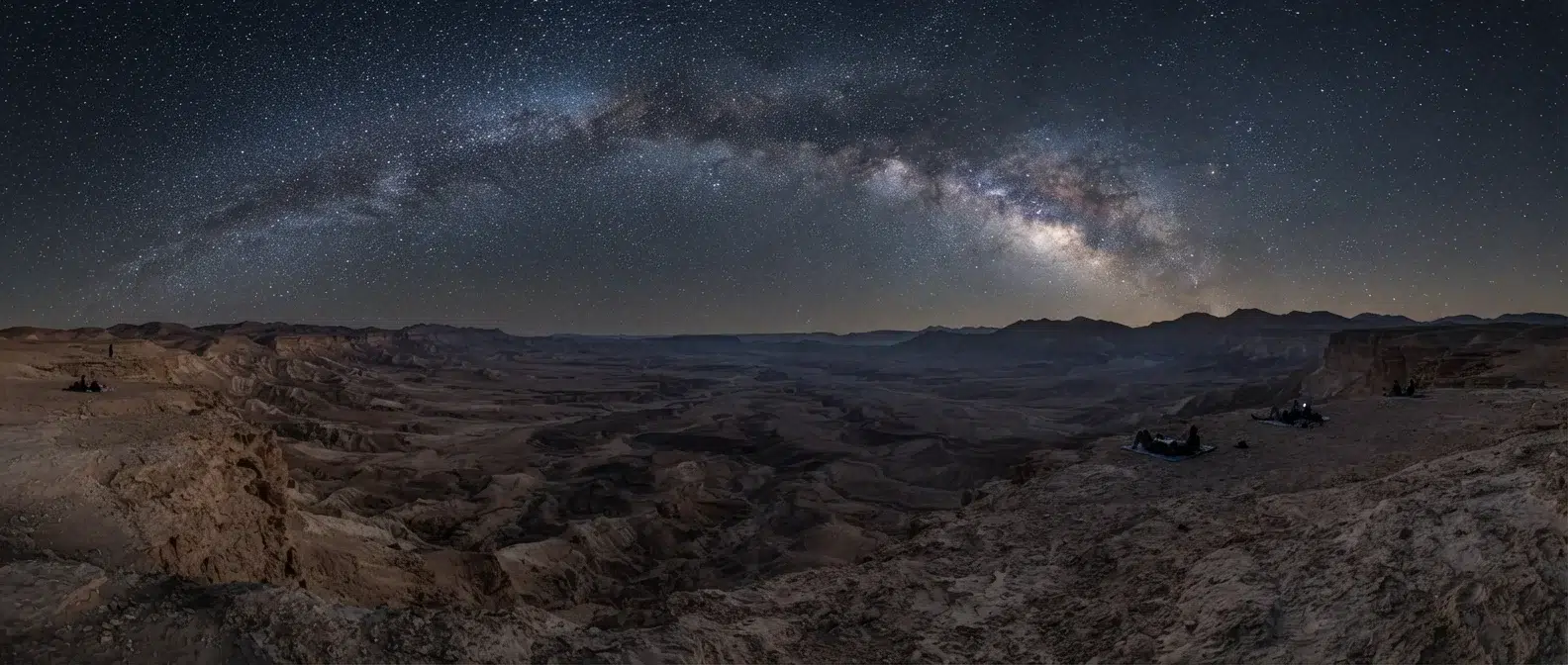
Human eyes need about 40 minutes in the dark to reach full night vision. Spend them lying on a mat in the Ramon Crater, away from headlights and phone screens, and something happens. The sky fills in. Faint stars appear between the bright ones, then more behind those, and a pale band that you first mistake for a cloud turns out to be the Milky Way.
That is why people travel to the Ramon Crater for stargazing. In September 2017, the International Dark-Sky Association named the Ramon Crater Nature Reserve an International Dark Sky Park, the first in the Middle East. This guide covers when to go, where to stand, what to bring, and how to fit a night under the stars into a day of desert travel.
Why the sky is so dark here
Three things work together. The crater is a huge bowl in a remote part of the desert, so the cliffs help block the glow of faraway towns. The air is dry, and clear nights are common. And people have made an effort. The Israel Nature and Parks Authority went through about three years of assessment to win the title, the western part of the crater is kept as an undisturbed dark core, and lighting near the eastern campgrounds is controlled to limit spill. The town of Mitzpe Ramon, on the rim, has also changed how it lights its streets.
The result is not total darkness. The town still glows on the horizon, and that is worth remembering when you choose where to stand.
Step one: check the Moon
After clouds, the Moon matters more than anything. A bright Moon washes out the Milky Way and most faint stars. For the best night, plan for the four or five nights on either side of a new moon.
If you are reading this at the end of October 2026, the Moon is full this week, so the dark nights return in early November.
| New moon (around) | Darkest nights (approx.) | Also in the sky |
| November 9, 2026 | November 5 to 13 | Taurid meteors (peaks November 4–5 and 11–12). The Leonids peak on November 17–18, with the Moon setting around midnight, so look after midnight |
| December 9, 2026 | December 5 to 13 | The Geminids peak on December 13–14 under a thin crescent Moon, which makes this a good year for them |
Dates differ by a few hours between sources, so check a moon-phase app before you book. A moonlit night is not wasted either. The Moon itself, the planets and bright star clusters look excellent through a telescope, and guided sessions in Mitzpe Ramon run around the full moon too.
What you can see, season by season
The Milky Way is a seasonal show, and it is worth knowing what to expect before you come.
| Season | What to look for |
| Spring to early autumn (about March to September) | The thick, bright core of the Milky Way low in the southern sky after dark. This is the famous view, and it is at its best in midsummer. Summer days are very hot, so plan for that |
| Mid-August | The Perseid meteor shower, around August 12–13 |
| Autumn (October and November) | A thinner Milky Way band arching overhead, and the Andromeda galaxy, which a dark sky lets you see with the naked eye |
| Winter (December to February) | Orion, the Pleiades, Sirius and the fainter winter Milky Way. Nights are long, but cold and windy |
The brightest Milky Way is a spring and summer sight. If you come in winter you get a different show, not a worse one.
Where to stand for Stargazing in the Ramon Crater
There are three kinds of places, and each suits a different group.
On the rim, near town. The Mitzpe Ramon promenade and the Desert Sculpture Park sit on the edge of the cliff. They are easy to reach and the views are huge, but they are closest to the town’s light. In the dark, the cliff edge is a real hazard, so go on foot, arrive before dusk, and keep well back.
Inside the crater. Several free spots along the roads, including parking areas, are good for lying back and looking up. The local tourism site lists them and they are on Waze. Park well off the road, switch off your headlights, and walk a short way from your vehicle. Never drive off the marked tracks, and do not park near the research observatory, which sits in a nature reserve with sensors that detect vehicles.
With a local astronomer. Guided telescope sessions run most evenings in Mitzpe Ramon. Groups of about eight or more can book them. Guides bring telescopes and show you planets, the Moon’s craters and star clusters, and they explain what you are looking at.
One night, step by step
- Before sunset. Walk your spot in daylight. Note the cliff edges, the rocks and where the cars are parked.
- Sunset plus 30 minutes. The sky turns blue and purple. Spread out your mat, put on your warm layer, and pour the tea. Dim your phone or switch it off.
- About an hour and a half after sunset. True darkness arrives. Now the 40 minutes of eye adjustment starts. Use a red light only.
- Two to three hours after sunset. The first great view. In summer the Milky Way core is high. In winter it is Orion.
- After midnight. Meteors become more frequent as your side of the Earth turns into the stream of dust. If you are watching a meteor shower, stay up.
- Before you leave. Check that no one is behind a moving car, and pick up every piece of rubbish.
What to bring for Stargazing in the Ramon Crater
- A mat or blanket, because the desert floor is hard and cold
- Warm layers, a hat and gloves. At the rim the wind can make it feel much colder than the thermometer says
- A red torch, or a phone with a red screen filter, since white light ruins night vision
- A thermos with something hot, and snacks
- Binoculars (7×50 or 10×50 are a good size), which show far more than you expect
- A star-map app with a night mode
- A camera and tripod, if you want photos
- A small first-aid kit, water, and a bag for your rubbish
For photos: use a wide-angle lens, the widest aperture you have, an exposure of 15 to 20 seconds, ISO 3200 to 6400, and manual focus set on a bright star. Longer exposures turn stars into short lines.
Rules of the dark
The Ramon Crater is busy on good nights, so a few simple rules help everyone.
- Switch off headlights, and do not shine white light into the distance.
- Keep quiet and leave the music at home.
- No fires and no tents outside permitted places. Do not leave tire tracks in the desert.
- Do not lift stones, because scorpions live under them. Keep children away from parked cars and cliff edges.
- Take all rubbish with you. Litter harms the animals that come after you.
How to fit stargazing into a day on the road
The usual mistake is to treat the night sky as an extra after a full day of driving. By nine in the evening everyone is tired and cold, and the sky gets half of their attention. It works better as the closing act of the day.
A day that works:
- Morning: the long off-road drive, while everyone has energy.
- Midday: a slow picnic lunch, then a real rest in the heat.
- Late afternoon: a viewpoint over the crater for sunset.
- Early dinner, so that no one stands in the cold hungry.
- Stargazing for an hour or two, close to where you sleep.
- Sleep near the crater rim, so there is no night drive back.
Pick a night with no early start the next morning, and keep a plan B. If clouds or wind spoil the sky, the Ramon Crater at sunrise is one of the best views in Israel.
Five mistakes that spoil the night
- Coming on a full-moon night and expecting the Milky Way.
- Looking at your phone, which resets your eyes.
- Leaving after 20 minutes, before your eyes have adjusted.
- Wearing too little. The desert is cold at night, even after a hot day.
- Expecting pitch darkness at the town promenade, which has the most light.
Can I see the Milky Way with the naked eye in the Ramon Crater?
Yes, on a clear, moonless night, once your eyes have adjusted. In spring and summer the bright core is the highlight. In autumn and winter you see a fainter band across the sky. Clouds, dust and wind can spoil a night, so plan two nights if your schedule allows.
Do I need a telescope or a guide?
No. Your eyes and a pair of binoculars show a great deal. A guided session adds a telescope and an astronomer’s explanations, which is useful if you want to see planets, the Moon’s craters and star clusters. Local guides run sessions most evenings, and groups of about eight or more can book.
How cold does it get, and is it safe for children?
Even in warm months, the temperature can fall by around 15°C between day and night, and the wind at the rim makes it feel colder. Winter nights can get close to freezing. Dress in layers, bring blankets, and keep children close, away from cliff edges and vehicles. Bring a first-aid kit, because the nearest pharmacy will be closed.
A night under the Ramon Crater sky, on one of our routes
We at Israel Jeep Tourism do run a southern route that ends near the Ramon Crater. On Day 4 of 5 Days of Craters, the group drives off-road through the Great Crater toward a spectacular view of the Ramon Crater and sleeps near the craters. That night is the natural place for a stop under the stars.
We do not follow the same plan every time. If your group would like a night-sky stop built into the route, with a dark spot away from town lights, an early dinner, and perhaps a session with a local astronomer, tell us and we will talk it through before anything is booked. Some of it is easy to arrange. Other parts need more planning, and we will tell you honestly which is which. If you can choose your dates around the new moon, say so, and we will help you check the moon calendar. Read more in How to Plan a Customized Tour in Israel for Your Group.
Request a proposal for 5 Days of Craters, or write to us at info@ijeept.com or on WhatsApp at +972-50-2288991. Tell us your group size, your dates and the night-sky stop you have in mind.